Click here to read highlights from the story
- Wisconsin’s statewide economic development agency has signed at least five nondisclosure agreements (NDAs) with data center developers.
- Wisconsin Watch previously reported that five communities had signed local NDAs with data center developers. The statewide disclosure increases to eight the number of Wisconsin projects that used an NDA.
- NDAs have drawn criticism for keeping the public in the dark about the multibillion-dollar projects while government officials negotiate the terms of a project. Economic development officials say NDAs are necessary to attract businesses to Wisconsin.
Wisconsin’s statewide economic development agency has signed at least five nondisclosure agreements with developers of artificial intelligence data centers, adding a previously unknown level of secrecy to the billion-dollar projects.
The Wisconsin Economic Development Corp., a quasi-government state agency, signed one of the NDAs nearly two years before a proposed data center in Menomonie was announced to the public and six months before the city signed its own NDA.
Wisconsin Watch previously revealed that at least five communities signed local NDAs, keeping the public in the dark about data center proposals for months.
The newly released state agency NDAs show that in some cases, the proposals were hidden from view even longer. Also, three of the NDAs signed by the state agency are for projects proposed in communities that didn’t have a local secrecy pact.
The agreements, provided to Wisconsin Watch under the state public records law, show the gap in time between when the WEDC NDAs were signed and when the data center proposals were publicly announced:
- Menomonie — 23 months: The August 2023 NDA, signed with a shell company called Balloonist LLC, was done 23 months before the city announced the data center proposal, which is pending.
- Beaver Dam — 19 months: The NDA for the Meta data center now under construction in Beaver Dam, also signed in August 2023 by Balloonist, was done 19 months before the project was announced to the public.
- DeForest — 8 months: The NDA was signed in February 2025 with QTS Data Centers, eight months before the public announcement of the proposal, which was later dropped.
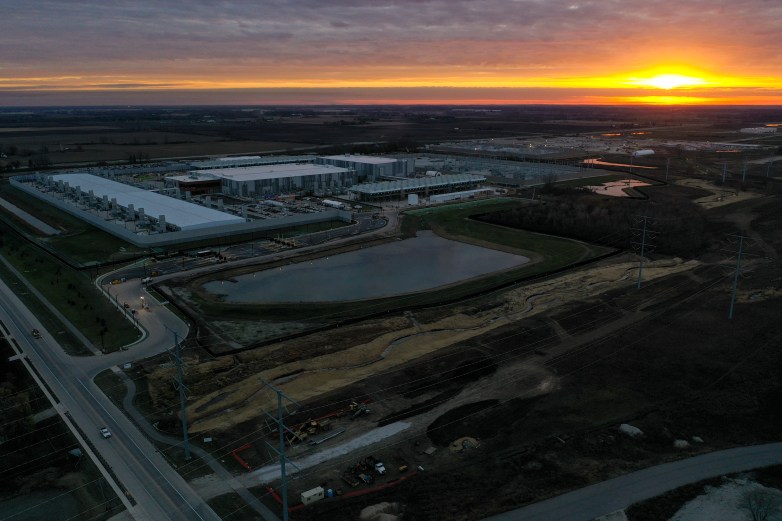
- Mount Pleasant — 2 months: Microsoft’s NDA was signed in January 2023, two months before the village announced the proposed data center complex that is now under construction.
- Port Washington: The July 2025 NDAs signed for the OpenAI/Oracle/Vantage project under construction were done six months after the city announced the proposal.
WEDC replied to an interview request with a statement saying “the agency is committed to transparency and compliance with Wisconsin’s public records laws and has long been recognized for its strong commitment to reporting.”
“Wisconsin law recognizes that certain information related to pending economic development projects may need to remain confidential to protect their competitive nature,” the agency said. “NDAs are one tool used to facilitate the exchange of business information while companies evaluate potential investments, expansions, or relocations in Wisconsin. These agreements help Wisconsin compete for economic opportunities while remaining consistent with applicable public records laws.”


Told about WEDC’s use of NDAs, state Rep. Clint Moses, R-Menomonie, said he would add the state agency to legislation banning data center NDAs that he plans to introduce in January, after a new governor and Legislature take office.
His original bill, introduced in January but given no hearings, would have applied only to local governments.
“I would assume they wouldn’t like it,” Moses said of the WEDC. “I know certain groups … kind of frown on any time you start banning NDAs. But these data centers are such a big issue, and there’s so much unknown about them still, that we need to be doing something.
“I think regardless who the governor is and who has control of the Legislature, I think it’s popular,” Moses added. “I think it will get support, regardless.”
Behind the WEDC and confidentiality
WEDC is the state’s lead economic development agency. It aims to attract new businesses to the state by allocating tax credits, awarding grants and loans and authorizing local governments to issue bonds.
The state law that created WEDC in 2011 says agency records are open to the public — except for “pending grants, loans, or economic development projects that, in the opinion of the corporation, must remain confidential to protect the competitive nature of the grant, loan, or project.”
That means proposed data centers costing billions of dollars and covering hundreds of acres could be quietly explored long before local residents are informed.
“It just seems like really bad practice,” said Port Washington Ald. Michael Beaster, who opposed his community’s data center and made public records requests about it before being elected in April. “A state agency is not accountable to the local government.”
The NDA record requests
Wisconsin Watch sought to obtain all NDAs signed by WEDC for hyperscale data center proposals. However, the agency was unable to produce all NDAs in its records in response to a general public records request for them.
The agency initially provided NDAs for three data centers that it certified for a state sales tax exemption and are under construction — Microsoft’s in Mount Pleasant, Meta’s in Beaver Dam and OpenAI/Oracle/Vantage’s in Port Washington.
Mount Pleasant and Port Washington replied to previous public records requests from Wisconsin Watch saying they did not sign NDAs for their data centers. The Beaver Dam Area Development Corp., a quasi-government group, signed an NDA for the Beaver Dam data center.
Wisconsin Watch then followed up with a request for any NDAs that WEDC signed with at least 16 companies that Wisconsin Watch identified as making data center proposals in the state. That prompted WEDC to provide its Menomonie and DeForest NDAs.
No data center NDAs were turned up by public records requests Wisconsin Watch made to the state’s nine regional economic development agencies.
Six of the regional agencies said the public records law doesn’t apply to them. But three of those six, plus three others, said they had no such NDAs.
NDAs helped usher in massive economic development
The NDAs helped pave the way for multibillion-dollar developments, but also public backlash.
Microsoft’s plans have grown to $20 billion worth of data centers in Mount Pleasant, south of Milwaukee in Racine County. The OpenAI/Oracle/Vantage project is worth $15 billion in Port Washington, north of Milwaukee in Ozaukee County. Meta’s data center investment is $1 billion in Beaver Dam, 40 miles north of Madison in Dodge County.
Data centers have also been worth billions of dollars to Wisconsin businesses that serve them. Earlier this year, just three Wisconsin companies had already done more than $1 billion in data center business, Wisconsin Watch reported.
“Non-disclosure agreements are an essential part of doing business in a competitive economic development climate,” the Metropolitan Milwaukee Association of Commerce said in a statement to Wisconsin Watch. “Companies considering major investments don’t evaluate locations singularly. They compare us with communities across the country, and they expect legitimate trade secrets and proprietary business information to remain confidential while making those decisions. If we make it harder to protect that information, we put ourselves at a competitive disadvantage and risk losing that investment altogether. That means a loss of jobs, tax base and economic momentum. To our knowledge, not a single state prohibits its economic development arm from utilizing NDAs.”

Another measure of data centers’ impact is the sales tax exemption, part of the 2023-25 state budget. It means that generally, data centers certified by the WEDC, including the three facilities under construction, don’t have to pay sales taxes on construction materials, computer servers and other equipment. The exemption is estimated to be worth more than $2 billion and has been targeted by Democrats and Republicans for modification or elimination.
The $1.6 billion data center proposal in Menomonie in western Wisconsin, where $25 million in land has already been purchased, was paused in September 2025 after local opposition mounted. The city is still drafting zoning regulations. The city signed an NDA in February 2024, six months after the WEDC secrecy agreement.
QTS had planned to spend $12 billion on a data center in the Madison suburb of DeForest. The village, which said it did not sign an NDA, reached a wide-ranging community benefits agreement with QTS, but village officials dropped the plan over local opposition. Wisconsin Watch obtained records showing village officials were in talks with QTS around the same time WEDC signed a nondisclosure agreement and months before village officials initially told the public they were aware of the project.
At least two Wisconsin communities have restricted data center NDAs. The Columbia County Board prohibited its members from signing data center NDAs. The Beloit Town Board barred town board employees from signing them without board approval.
Both candidates for governor in the Nov. 3 election, Democrat David Crowley and Republican Tom Tiffany, have expressed support for banning data center NDAs.
More data centers being considered
Data center proposals that are pending include one for a former paper mill in Wisconsin Rapids, north of Madison, where a decisive city council vote could come this month. The city said it did not sign an NDA.
In Kenosha, which signed an NDA in May 2024, residents are seeking a data center moratorium as the city considers a data center plan from Microsoft. The technology giant terminated the local NDA in June 2026.
That stemmed from Microsoft’s announcement three months earlier that it would no longer sign data center NDAs with local governments and would seek to terminate the ones it had signed, calling it an effort to build trust.
The announcement didn’t mention state-level NDAs. A Microsoft spokesperson declined to comment on state NDAs.
“We continue to hear these data centers and tech companies talking about wanting to be a good neighbor,” said Beaver Dam data center opponent Maily Kocinski. “This is not something a good neighbor does.”
Disclosure: The OpenAI Foundation recently awarded a grant to Wisconsin Watch but has no control over its editorial decisions. We will update our funding page to reflect the grant. A list of donors and funders through 2025, as well as our donation acceptance policies, can be found here.

Wisconsin Watch is a nonprofit, nonpartisan newsroom. Subscribe to our newsletters for original stories and our Friday news roundup.