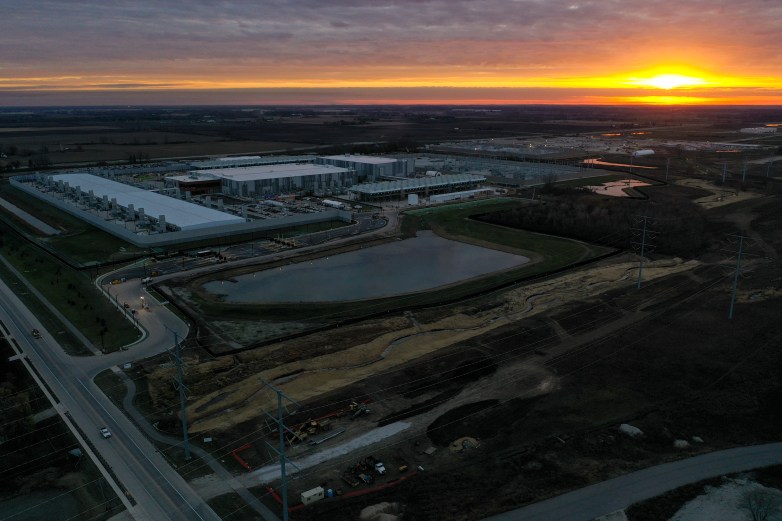
No matter where in the U.S. an artificial intelligence data center is proposed, communities express the same worries.
Water scarcity and contamination, electricity rates and reliability, air pollution, noise.
Residents are voicing those same concerns 100 miles north of Madison in Wisconsin Rapids, where developers want to replace a former paper mill with a 210-acre data center.
But there’s another worry in Rapids that makes the situation different from other Wisconsin communities where data centers have been proposed:
Russians.
“I hear it from other people; people bring it up very often,” data center opponent Mary Olson said.
Ruslan Zinurov, the man who first proposed the data center, was born in Russia.
Anton Voronkin, who has since taken over the project, was born and educated in Russia and worked there for years.
Marissa Johnson, a leader of a group fighting the data center, said that while residents have environmental concerns, the Russian ties are “a sticking point for people.” Some residents don’t say so publicly, out of fear of being perceived as xenophobic, but they worry about the developers’ past business practices, she said.

The questions aren’t limited to whispering.
At public meetings, residents mostly express common fears: How much water will the data center use? Will my electricity rates go up? How can we know it won’t cause air and noise pollution?
One woman urged city officials to “just do the right damn thing” and find any way to block data centers.
But at a city meeting in July, a woman said a “Russian national” had applied to the city for a permit for the data center.
In August, at a meeting organized by the team proposing the data center, one audience member drew applause from the audience when he said to Voronkin:
“We like to know who’s running this operation. And from what I understand, you, sir, are not an American citizen; you’re Russian. Am I right or wrong?”
Voronkin’s reply didn’t seem to satisfy the crowd. “I have worked in many countries overseas,” he said.
Russian born, Green Bay ties
The first record of the data center proposal is an email sent Dec. 16 by Zinurov to Wisconsin Rapids city planner Kyle Kearns. He wrote that he was looking to acquire a site in the city of 19,000 to convert into a data center.
The location turned out to be part of a former paper mill site near downtown and the Wisconsin River.
Kearns replied the next day, writing: “It is exciting to hear about your interest!”
By February, Zinurov had met with Kearns and Mayor Matt Zacher. He said in an email that he was working to acquire part of the mill site. He wondered if the city could help secure electricity and natural gas for the operation.
The proposal didn’t make news until April, when the city planning commission announced a public hearing on Zinurov’s application for what is known as a conditional use permit.


The 43-year-old Zinurov identified himself as being with California-based Performance Computing Holdings. In a 2020 article about a Zinurov-led investment in Ukraine, Zinurov told the Kyiv Post he was born in Russia, his wife is Ukrainian and he had been living in the U.S. more than 15 years.
He also has Wisconsin ties.
Zinurov’s cellphone number has a 920 area code, which covers Green Bay. According to his LinkedIn profile, he has a bachelor’s degree in business administration from the University of Wisconsin-Green Bay, plus a master’s degree in the same subject from the University of California, Berkeley.
Zinurov’s profile also says he founded a company originally known as Consensus Technology Group. In a 2024 interview, he said that company operates data centers in North Dakota, South Dakota, Pennsylvania and Missouri.
According to news reports, Zinurov also partnered with Chinese tech company Bitmain to convert a former paper mill in Washington state into a cryptocurrency-mining business.
Vinurov declined Wisconsin Watch’s requests for an interview, noting in a text that Voronkin has taken over the Wisconsin Rapids project.
Vinurov wrote that he “spent a good chunk of my life in Green Bay, so Wisconsin indeed has a special place in my heart. Go Pack.”
New face of the project
As Zinurov has worked behind the scenes, Voronkin, 42, has become the public face of the Rapids proposal.
By early May, a week after Zinurov filed the permit application, city planner Kearns had turned to emailing with Voronkin instead. Kearns noted that Voronkin and one of his team members, former New York City Mayor Eric Adams, had made plans to visit Wisconsin Rapids.
Adams’ background has also riled some residents. While mayor, he was indicted on federal conspiracy charges, which he denied. In April 2025, the charges were dismissed at the request of the U.S. Justice Department.
Voronkin, who was born in Russia, says in his LinkedIn profile that he earned bachelor’s and master’s degrees in St. Petersburg, Russia. The profile says he worked in commercial development in Russia from 2009 to 2022, when he began development work on Neom, a $500 billion mega-project in Saudi Arabia.
The nonprofit group Human Rights Watch reported in December 2024 that Neom workers suffered abuse, such as being paid less than they were promised. The same month, a Wall Street Journal investigation found Neom employees reported incidents of gang rape, suicide, attempted murder and drug dealing on the site.
In 2026, Voronkin became chief development officer, including for data centers, at PNK Group, a New York-based developer of industrial buildings.

PNK began operations in Russia around 2003, according to the Scranton Times-Tribune in Pennsylvania, where PNK is proposing a data center.
Voronkin said at the August meeting in Wisconsin Rapids hosted by his team that PNK “withdrew the brand from Russia in 2024.”
Data center opponent Mike Schmidt, a local attorney, said he doesn’t trust PNK because of Voronkin’s work with Neom and what Schmidt described as corruption allegations against PNK owner Andrey Sharkov.
In two federal court lawsuits over business matters, Sharkov is accused of fraud in Pennsylvania and is the subject of a racketeer/corrupt organization lawsuit in Utah. Both cases are pending, and Sharkov has denied the allegations.
“It’s not just that they’re Russian, it’s that they’re behaving in a corrupt fashion,” Schmidt said of Voronkin and Sharkov.
Voronkin declined Wisconsin Watch requests for an interview. In messages, he wrote:
“I am not aware of such concern about my work for Neom. I am proud to be a part of the biggest development in the world and most likely in history. I wish more people had same level of ambitions and could think about the future same way as Neom. There are no corruption charges against Andrey Sharkov.”
He added:
“I have indeed worked on some unique projects, but I don’t think my background is the most exciting subject for Wisconsin Rapids.”

City nearly poised to act?
Mayor Zacher told Wisconsin Watch that perhaps 15 data center developers and another 15 manufacturers have explored the former mill site but most didn’t move forward. According to his understanding, most data center developers didn’t think enough electricity was available.
Zacher said he has tried to remain neutral as the current data center proposal has advanced and opposition has increased. The city must consider business proposals based on the project’s merits, not who makes them, he said.
Voronkin’s group has continued to try to build local support, holding a series of four webinars in August.
Zacher said the city is waiting for Voronkin’s group to provide more details on their proposal before it acts on their application for a conditional use permit and indicated the waiting time is limited.
“I would say we don’t want to go months,” he said.

Wisconsin Watch is a nonprofit, nonpartisan newsroom. Subscribe to our newsletters for original stories and our Friday news roundup.