A dozen Wisconsin state lawmakers are urging the Federal Energy Regulatory Commission to reject a utility coalition’s request to pause competition for major electrical transmission projects in the Midwest.
The lawmakers — eight Assembly Republicans and four Senate Republicans — argued in a letter to the commission that competition for electrical transmission is a net positive for ratepayers, who stand to benefit from lower costs and increased innovation. That outcome, lawmakers wrote, “is even more urgent today given the rising issue of customer affordability.”
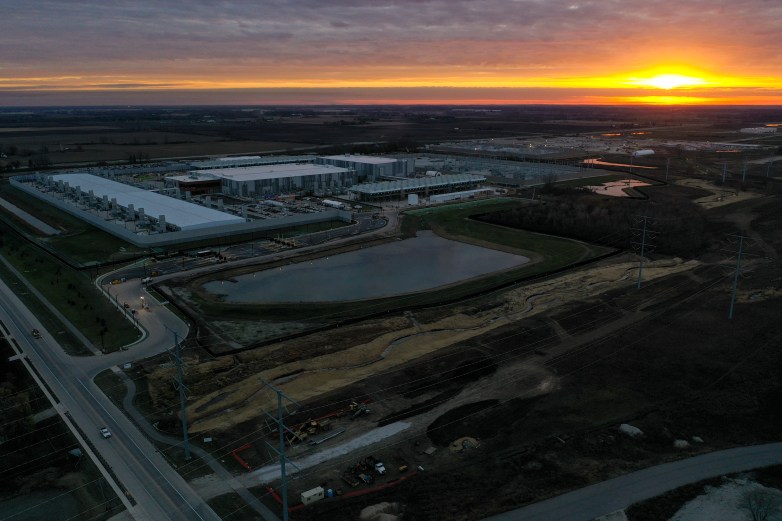
The utilities requesting a pause dispute whether competition truly lowers final costs for customers, but that argument is secondary to their primary concern: Powering the Midwest’s data center boom will require vast electrical transmission upgrades, and major regional utilities argue that competition only slows down projects needed to bring data centers online before international competitors overtake the U.S. in the artificial intelligence race.
Among the utilities behind the request are Xcel Energy, owner of Northern States Power Company-Wisconsin, and American Transmission Company (ATC), Wisconsin’s largest electrical transmission operator.
The state lawmakers cast the utilities’ request as the latest stage of a long-standing fight over transmission market competition — one that has unfolded in the Assembly over the last five years.
Data center boom intensifies transmission competition
Ratepayer advocacy groups successfully lobbied FERC, which oversees utilities nationwide, to introduce competitive bidding for regional transmission projects in 2011, arguing that the previous model — allowing local monopolies to build all projects planned within their territories — all but guaranteed inflated costs.
The shift triggered a nationwide gold rush for transmission projects. Regulators pre-approve developers’ “return on equity,” or profit on each dollar invested, for transmission construction, so winning a project means picking up a reliable revenue stream.
Dozens of developers have since bid on transmission projects planned by the Midcontinent Independent System Operator (MISO), the nonprofit that manages the wholesale electricity market for much of the Midwest. MISO has approved more than $32 billion in new transmission projects since 2022 — projects largely planned before the region’s data center boom reached full swing.
The rush to win projects has placed well-established local utilities like ATC in competition with powerful national utilities venturing outside of their traditional territory, international developers venturing into the U.S. market, and startups backed by private equity firms.


As data center developers rapidly scale up Midwest operations, the pace of transmission upgrades could become a choke point.
In March, MISO reversed its decision to award substations in Fond du Lac, Ozaukee and Sheboygan counties to private-equity-backed startup Viridon, instead handing the projects to ATC.
ATC’s initial bid was more expensive than Viridon’s, but the company successfully argued it alone could build the substations in time to serve the nearby Vantage data center campus in Port Washington. Viridon had not yet secured Public Service Commission permission to operate in Wisconsin — a hurdle ATC does not face.
MISO initially aimed to complete the substations by 2033; the Port Washington data center plans to come online in early 2028. Though ATC emerged victorious, it told FERC that the 15-month delay between MISO’s initial approval of the substations and the reversal was “completely unnecessary.”
Utilities say competition slows projects needed for AI growth
In the utility coalition’s initial request to FERC, it cast competition-related delays as a national security threat.
“These projects — expressways for power — are as critical to meeting today’s challenges as the Eisenhower interstate highway system was to prevailing in the Cold War,” the utilities argued in their initial filing. “China has devoted itself to overtaking America as the world’s AI leader and is just months behind.”

The utility coalition proposed two options: Allow MISO, along with the grid operator for parts of the Great Plains and Southwest, to exempt transmission projects from competitive bidding on a case-by-case basis or suspend competition entirely for the next five years — “when our country must begin building the infrastructure that will decide which nation wins the AI race,” the utilities wrote.
Ratepayer advocacy groups immediately pushed back. Paul Cicio, chair of the nationwide Electricity Transmission Competition Coalition, called the request “tone deaf.”
“Suspending competition for five years,” he wrote in a press release, “would expose consumers in these regions to unchecked cost escalation for years, guaranteeing higher utility bills.”
In a protest filed with FERC in late May, Wisconsin’s Citizens Utility Board pointed to the Cardinal-Hickory Creek transmission line in southern Wisconsin as an example: The 102-mile project was not subject to competitive bidding, and construction costs came in roughly 40% over budget by the time ATC, Dairyland Power Cooperative and ITC Midwest completed the line in fall 2024.
Opponents of the utilities’ request recognize that the data center boom complicates the playing field for transmission competition.
“Timelines are looking different than the industry is used to,” said Caitlin Marquis, managing director of Advanced Energy United, a trade group representing an array of clean energy and energy efficiency industries. “Transmission competition has been facing curveballs and challenges since it was introduced,” she added. Many challenges result from lobbying by incumbent utilities, and data centers’ speedy construction cycles are only the latest addition.
Her organization opposes the utilities’ request, arguing that incumbent utilities have a long track record of delaying non-competitive transmission projects — and that regulators should streamline the bidding process rather than forego competition entirely.
But utilities argue competitive bidding has yet to prove its worth. While MISO generally favors lower-cost bids, an ATC spokesperson wrote in an email to Wisconsin Watch, “evidence of a low bid is not evidence of cost savings.”
Bid prices often do not match the final project cost, they added, and substantial overruns are common, even on projects with competitive bidding.
Federal fight echoes years of debate in Wisconsin
As regional grid operators introduced competitive bidding for transmission projects a decade ago, utilities turned to state legislatures for right-of-first-refusal, or ROFR, laws.
Those laws give local utilities first dibs on transmission projects within their territories, including those planned by regional grid operators like MISO.
Michigan and Minnesota adopted such policies; Iowa’s Supreme Court struck down a ROFR law in 2023.

Utilities have backed similar proposals in Wisconsin each year since 2021, including a 2025 bill introduced by outgoing Assembly Speaker Robin Vos, R-Rochester.
Those proposals would have “insulat(ed) incumbents from market discipline” and left ratepayers holding the bag, the Wisconsin lawmakers argued to FERC.
“Having failed repeatedly to persuade the Wisconsin Legislature,” they continued, “the same incumbent entities are now pursuing an end-run at FERC.”
ATC maintains that options before FERC would “not operate as a substitute” for a ROFR law, “even temporarily.”
The utilities don’t stand alone before FERC. The International Brotherhood of Electrical Workers, a union representing the tradespeople who build and maintain transmission lines, also backs the request to pause competition.
Editor’s note: This story was updated June 4, 2026 to include comments from Caitlin Marquis, managing director of Advanced Energy United.

Wisconsin Watch is a nonprofit, nonpartisan newsroom. Subscribe to our newsletters for original stories and our Friday news roundup.