Click here to read highlights from the story
- Wisconsin once gave the Public Service Commission broad authority to guide utilities’ long-term energy planning, but lawmakers scrapped that system in 1998, shifting more control to utilities.
- Ratepayer advocates argue the hands-off approach incentivizes power plant construction over investments in energy efficiency and demand reduction.
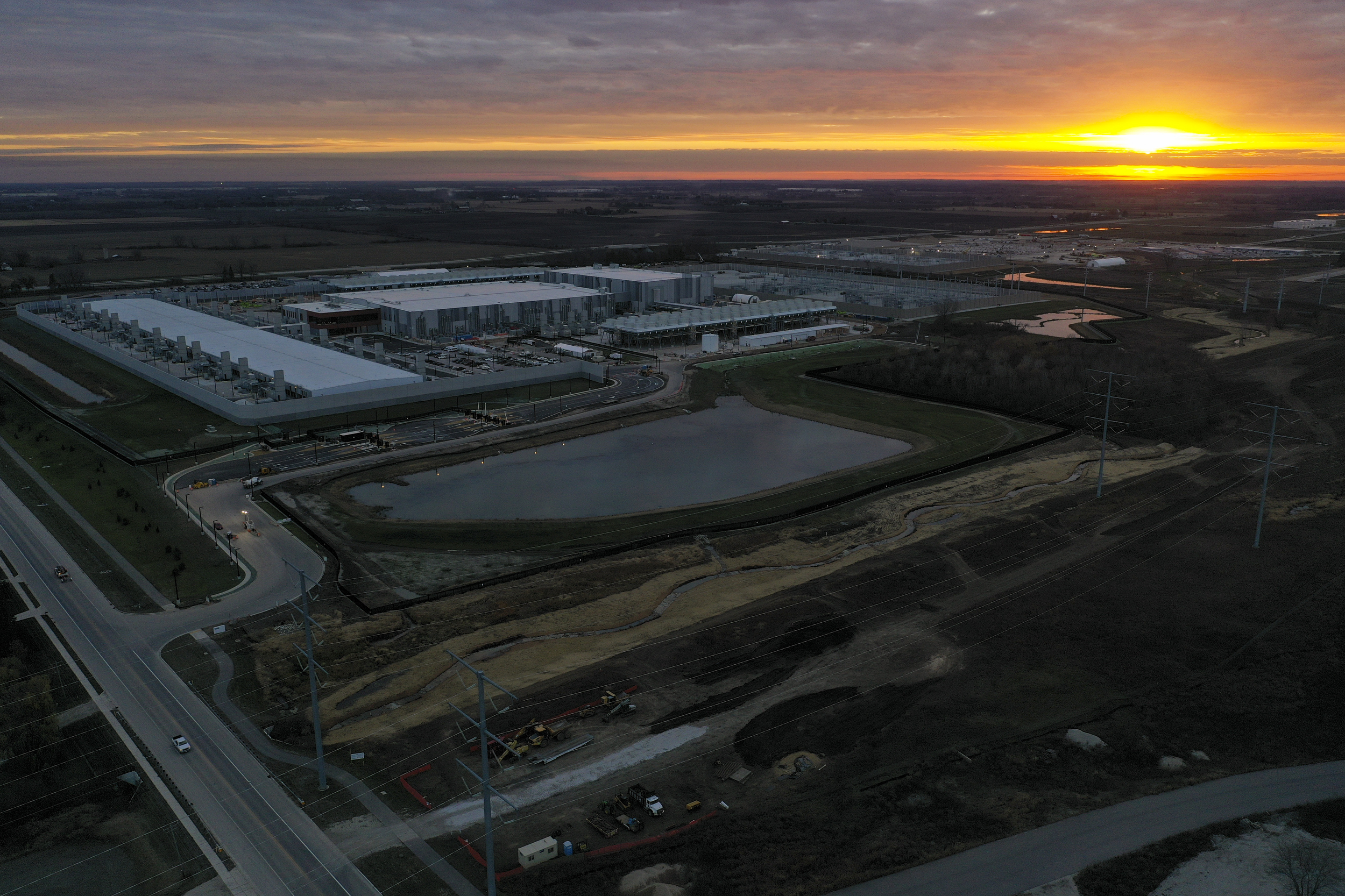
- A surge in electricity demand from data centers is driving a multibillion-dollar buildout and renewing calls for regulators to take a greater role in planning for future needs.
- Regulators say current law limits their ability to compare competing proposals and assess major projects as a package, prompting calls for lawmakers to reconsider the state’s approach.
Wisconsin’s electricity needs are on track to skyrocket. Utilities plan to spend billions of dollars to keep up, and ratepayers — residents, businesses and data center operators — will pick up the bill.
The three-member Public Service Commission, which regulates utilities, is responsible for guarding ratepayers’ wallets from unreasonable spending, but Wisconsin law gives it relatively little sway over how utilities plan for the future.
The commission can review proposed power plants on a case-by-case basis, but not as part of a broader blueprint for keeping the lights on as affordably as possible.
That hasn’t always been the case. Bureaucratic gridlock and a near-blackout prompted Wisconsin lawmakers to scrap a more hands-on approach to energy planning three decades ago.
Utilities don’t mourn its loss. Ratepayer advocates, however, argue the hands-off approach that followed caused Wisconsin’s electricity prices to climb faster than necessary.
A flurry of new power plant projects spurred in part by the data center boom is pushing that once-arcane disagreement into the public eye, and regulators themselves are now taking a side.
Wisconsin once gave regulators broad planning power
Investor-owned utilities generally operate as regulated monopolies: State and federal commissions grant them exclusive rights to sell electricity to consumers within a defined territory in exchange for government oversight of their rates and infrastructure projects.
That basic model dates back more than a century in Wisconsin, which formed its Public Service Commission — among the nation’s first utility regulators — in 1907.
The mass adoption of air conditioning and the rise of nuclear power complicated the picture in the mid-20th century.
Wisconsin lawmakers responded in the 1970s by empowering the Public Service Commission to take the lead on energy planning, hoping to steer utilities toward the most cost-effective path to meeting skyrocketing electricity demand.
Those powers took shape as the “Advanced Plan”: 20-year road maps for utilities to meet electricity needs. Working in two-year cycles alongside consumer advocates and other players, the commission could revise the road map to fit its priorities, and especially to save ratepayers money.
“This approach requires that the utilities focus on the most cost effective means of meeting customers’ energy service needs,” the commissioners explained in a 1987 biannual report.


Utilities have a strong incentive to build new power plants. Ratepayers pay for newly built plants, along with a commission-approved “rate of return” on every dollar spent on the projects, passed along to the utility’s shareholders. The commission could use the Advanced Plan to reconfigure utilities’ construction plans in search of savings. Later iterations embraced demand-side fixes, trimming future energy needs by incentivizing customers to switch to energy-efficient appliances or run factories at off-peak hours.
The PSC used its planning power to chip away at utility monopolies in 1989 by beginning to open utility-owned transmission lines to other power producers. Wisconsin was an early adopter of an open transmission system, hoping to keep prices in check by encouraging competition in the electricity market. State lawmakers later directed utilities to pass control of their transmission infrastructure to a new, independent company to protect other power producers’ access to the grid. That company, now called the American Transmission Company, was the country’s first multi-state, transmission-only utility.
The PSC went further in 1993, inviting third-party developers to bid for power plant projects outlined in utilities’ long-term plans. Commissioners awarded a natural gas plant in Whitewater to a New York-based developer later that year, saving We Energies’ customers an estimated $66 million.
Other states deregulated their electricity markets entirely. Chaos ensued, most notably in California, where flawed execution, price gouging and a drought caused regional blackouts, a major utility bankruptcy filing and billions of dollars in economic losses.
Lawmakers let utilities take the lead
Wisconsin didn’t copy California’s experiment. It did, however, scrap the Advanced Plan.
Utilities argued comprehensive planning was cumbersome and prone to gridlock, blaming it for a slowdown in power plant and transmission construction in the mid-1990s. Some commission staff also recognized the Advanced Plan’s deficiencies.

“It became an anti-utility regulatory mechanism that put electric reliability at risk,” recalled Randel Pilo, the PSC’s chief energy economist through much of the 1990s.
A close call in the summer of 1997 pushed Wisconsin’s political and business leaders, and even some ratepayer advocacy groups, to rethink the state’s approach. With nuclear power plants in Wisconsin and Illinois unexpectedly offline for repairs, utilities warned that summertime air conditioning use might stretch the state’s supply past its limits and trigger widespread blackouts.
State lawmakers abolished the Advanced Plan the following year. They replaced it with what Pilo called a “regulation-lite” approach, leaving planning for Wisconsin’s energy future mostly in utilities’ hands.
The PSC still considers the cost of and market justification for new power plants, but not as part of a broader strategy for balancing affordability and reliability.
Utilities made the most of the new landscape. We Energies embarked on a $7 billion “Power the Future” construction spree only a few years later — the largest energy buildout in Wisconsin history. The present power plant construction boom may surpass that record if projections of data centers’ energy needs prove accurate.
Shift to ‘regulation-lite’ approach
Ratepayer advocacy groups and some independent energy developers argue the “regulation-lite” approach to energy planning is taking a toll on Wisconsinites’ budgets.
“Without a robust planning process, we don’t have balance and we’re left with higher bills,” said Tom Content, executive director of the Wisconsin Citizens Utility Board. Under the current system, he argues, “utilities present their spending plans to investors eager for the higher profits that come from their build-build-build agenda.”
Had regulators retained greater energy planning authority, Content believes they might have more closely scrutinized We Energies’ investments in coal-fired generators just before the fracking boom made natural gas cheap and abundant in the late 2000s. Wisconsin’s average electricity rates — the second-lowest in the Midwest in 1998 — soared during the Power the Future buildout. They are the region’s second-highest as of August.

Former Republican Sen. Robert Cowles, a longtime ally of ratepayer advocacy groups who chaired the Senate’s energy committee at several points in his 38-year Senate tenure, voted alone against the 1998 bill. He told Wisconsin Watch that preserving advanced planning could have curbed some of those rate hikes by reducing demand through energy efficiency programs.
“To the extent that we can avoid building additional capacity, it saves us money,” he said.
Skeptics of the current system don’t uniformly oppose construction. A 2026 study by Advanced Energy United — a clean energy trade group that supports comprehensive planning — estimated that We Energies’ customers could have saved roughly $150 per year between 2021 and 2024 had the utility replaced its Elm Road plant with renewables and battery storage, in part by avoiding the cost of fueling and maintaining older coal and natural gas plants.
Utilities maintain that the PSC already has sufficient authority to protect ratepayer interests.
“State regulatory staff, intervenors and the public thoroughly evaluate our projects, including their costs compared to alternatives, environmental impacts, and the actual need for these new generation resources,” We Energies spokesperson Brendan Conway wrote in an email. “This robust review process ensures customers are protected every step of the way.”
How Wisconsin compares to neighboring states
Wisconsin’s current approach to energy planning sets it apart from most neighboring states — and most of the country.
Minnesota’s Public Utilities Commission has required utilities to develop comprehensive plans since the early 1990s. Illinois adopted the practice earlier this year, and Michigan lawmakers re-introduced comprehensive planning a decade ago during a transitional period in the energy sector.
“We knew that there were a number of plants that were scheduled for retirement,” said Michigan Public Service Commission chair Dan Scripps, and “a better planning process was needed” to replace them.
Michigan’s residential electricity prices nevertheless remain the highest in the Midwest, but supporters of the state’s planning approach argue other factors obscure the policy’s positive results.
“Michigan’s energy bills are driven much more by distribution system upgrades than by generation costs,” said Michigan Energy Innovation Council President Laura Sherman, citing years of deferred power line maintenance for power lines. “Without the long-term planning and competition,” she added, “I think we’d see higher generation costs as well.”
“It is effectively impossible to know what rates would be” had Michigan not adopted comprehensive energy planning, said Jonathan Kim, a Chicago-based researcher with the watchdog Energy and Policy Institute. Any number of variables — even weather — can skew comparisons between states that take a hands-on approach to planning and those that do not.
Iowans, for instance, pay the lowest retail electricity prices in the Midwest even without a comprehensive energy planning process. Kim attributes those low prices to Iowa’s early and speedy adoption of renewables, which spare the state’s ratepayers from “fossil fuel price instability.” Renewables, and especially wind turbines, account for roughly 60% of Iowa’s in-state electricity generation, compared to about 12% in Michigan and Wisconsin.
Kim also underscored that utilities can take advantage of the long-term energy planning process at ratepayers’ expense.
“We’ve seen utilities routinely overproject demand growth or need for new projects so that the amount they have to build seems greater,” he said. If regulators approve a utility’s construction to-do list in one go, Kim added, “the incentive for utilities to cheat the system, as well as the need for heightened scrutiny and rigorous ratepayer advocacy, grow even stronger.”
Data center boom revives planning debate
With a massive energy buildout on the near horizon, even Wisconsin’s regulators are joining the push to rethink the state’s energy planning paradigm.
The Public Service Commission’s most recent draft strategic energy assessment — a biennial forecast introduced as a nonbinding Advanced Plan substitute — projects Wisconsin’s energy use will climb by roughly 40% over the next five years, driven mostly by new data centers.
We Energies alone expects to spend nearly $50 billion on new infrastructure over that time frame.
Those plans await commission approval on a project-by-project basis. Among them: a pair of natural gas plants in southeastern Wisconsin.
We Energies isn’t building the plants itself. That responsibility falls to Invenergy, the nation’s largest independent energy infrastructure developer.
The same 1998 law that axed the Advanced Plan also streamlined permitting for independent “merchant plants” built to sell electricity on the wholesale market — a move lawmakers believed would spur competition. Invenergy’s proposed plants in Kenosha and Walworth counties qualify for that streamlined review, preventing commissioners from scrutinizing their price tags.
Invenergy brought the plants to the commission for approval last year. We Energies promptly applied to buy the facilities to power its data center customers for a combined $2.3 billion; that price tag has since climbed to roughly $2.8 billion.
While We Energies must still prove the natural gas plants would provide more reasonable prices than generators powered by a different fuel, it need not demonstrate that Invenergy offered a better deal than competing developers. Microsoft, which plans to “subscribe” to the Kenosha County plant’s power and pay for its purchase, declined to comment.
Wisconsin utilities have used the same maneuver at least a half-dozen times since 2018, mostly to develop solar and wind farms.
“When developers like Invenergy develop a project, they take on all the risk and responsibility of making that project viable, that protects our customers,” Conway wrote.

Commission Chair Summer Strand isn’t convinced. Speaking at the commission’s Oct. 15 hearing on Invenergy’s applications, Strand argued Wisconsin’s “piecemeal, often whack-a-mole approach” to energy planning enables the end-around.
Strand and her fellow commissioners emphasized that current law leaves them unable to consider the We Energies-Invenergy deal as a package, even if doing so could help identify a more cost-effective alternative. The commission approved Invenergy’s permits last month; it has yet to weigh in on We Energies’ purchase plans.
“The deficiencies in the current framework are ripe for legislative action,” Strand said.
Outgoing Gov. Tony Evers proposed granting the PSC comprehensive planning powers in his most recent draft budget, but the Republican-controlled Legislature rejected the provision. The question now falls to Gov.-elect David Crowley and a new Democratic-majority Legislature.
Pilo likewise believes Wisconsin’s energy planning model needs “modest reform,” even as he recalls the Advanced Plan’s flaws. In his view, a “major transformation” in Wisconsin’s energy sector calls for a planning model more focused on affordability, competition and “public stewardship.”
Ratepayer groups enthusiastically agree.
“It’s long overdue that we give the state the tools it lacks,” Content wrote in an October press release. “Until we do, the PSC is trying to guide the state down the ‘energy future highway’ without a GPS, or even a map.”

Wisconsin Watch is a nonprofit, nonpartisan newsroom. Subscribe to our newsletters for original stories and our Friday news roundup.