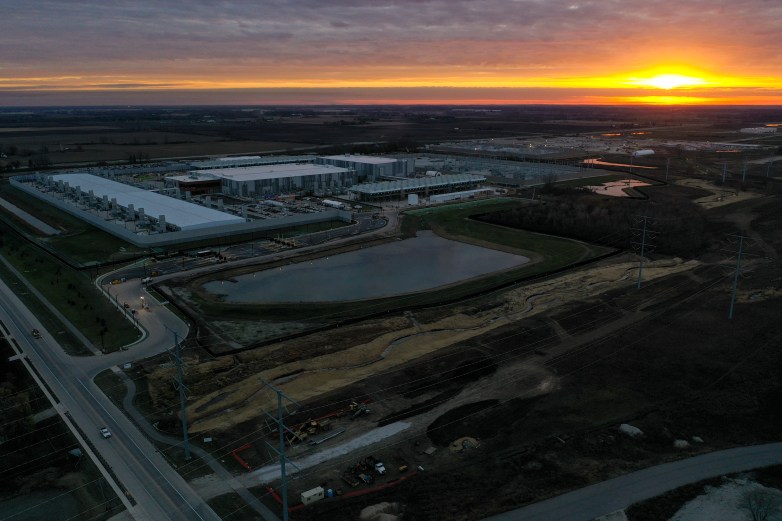
We Energies this week asked Wisconsin’s Public Service Commission to revisit its recent ruling on electrical rates for the utility’s data center customers, arguing new credit rating requirements create an undue burden for data center operators.
The PSC approved We Energies’ “very large customer” rate structure in April, requiring the utility to exclusively bill data center customers for new energy generation infrastructure needed to serve them, among other protections for existing ratepayers. The agreement also requires data center developers with credit ratings below A- to post financial guarantees, either in cash or lines of credit, to reduce the risk of shifting costs to other customers if a developer runs into financial trouble.
That requirement poses a problem for Oracle, which is partnering with OpenAI and Vantage to develop a vast data center campus in Port Washington.
The cloud computing giant currently holds a BBB credit rating — a tier below the A- bar set by the PSC, but still considered investment-grade by ratings agencies — largely due to aggressive borrowing to finance new artificial intelligence infrastructure. Under the current rate structure, the Oracle subsidiary involved in the Port Washington project would need to provide cash deposits or letters of credit exceeding $100 million per year to receive We Energies service.
“If the Commission does not reopen its decision on this issue, the implications for Wisconsin would be significant and limit the ability of numerous investment-grade companies to invest in Wisconsin,” the utility’s attorneys wrote in a June 10 filing.
Several other major technology companies — including Intel, Tesla and Micron — hold BBB credit ratings, the attorneys noted.


Ratepayer advocates backed credit limits for data center developers during the PSC’s deliberations on the case. In written testimony to the PSC in January, Wisconsin Citizens Utility Board chief economist Steve Kihm pointed to energy trading giant Enron, which held a BBB credit rating just a year before its 2001 bankruptcy, as a reason to be cautious with financial commitments from high-dollar investors.
In its request to reopen the case, We Energies argued that the risks of Oracle or other tech giants defaulting on obligations are extremely low.
“Tens of billions of dollars in Oracle’s value would need to be destroyed before creditors and counterparties, such as Wisconsin Electric and its other customers, could experience losses,” the utility’s attorneys wrote. Even in a bankruptcy, they added, generators built to serve data centers “will still have value and will be able to provide electricity to other customers” — as opposed to a scenario in which the generators sit idle while solvent ratepayers cover the debts We Energies incurred to build them.
We Energies and Oracle asked the PSC to consider a stepped approach to security requirements that eases the burden on companies with “investment-grade” credit ratings, including BBB ratings, and to waive the Oracle subsidiary’s financial backing obligations. The utility argued that its proposed waiver would still offer greater protections than those required from Meta in its recent agreement with Wisconsin Power and Light, a subsidiary of Alliant Energy.
But Union of Concerned Scientists energy analyst Maria Chavez pointed out that We Energies’ arrangements with new hyperscale data center customers differ from Meta’s one-off service agreement with Alliant. Meta isn’t “specifically asking for extra generation capacity assets to be added,” she said, whereas the Port Washington data center campus — and Microsoft’s data center in Mount Pleasant — will require new, dedicated energy sources.
“The greater risk to ratepayers,” she added, “the more reason to have a high standard for financial security requirements.”
We Energies and Oracle urged the commission to “move quickly” on the issue to “provide certainty for generational investments that are currently moving forward in this state.”
Meanwhile, Oracle’s share value tumbled this week amid uncertainty about its data center investments. The company’s debt-to-equity ratio exceeded 400% as of May, whereas other hyperscale data operators maintain ratios of 80% or lower.

Wisconsin Watch is a nonprofit, nonpartisan newsroom. Subscribe to our newsletters for original stories and our Friday news roundup.